


Gender Pay Gap Statistics - March 2025
We continue to welcome the Government’s requirement for large organisations to be more transparent on gender pay, and will use this opportunity to nurture our culture of supporting women in the workplace, ensuring success is defined by talent, not gender or circumstance.
What is a gender pay gap?
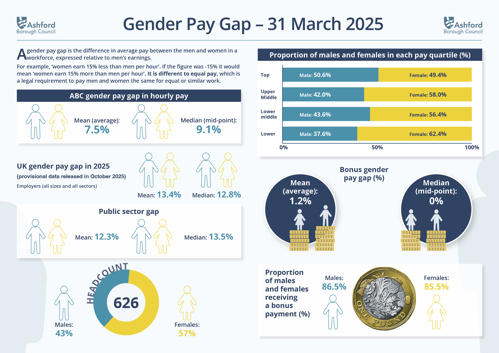
A gender pay gap is the difference in average pay between the men and women in a workforce, expressed relative to men’s earnings. For example, ‘women earn 15% less than men per hour’.
It is different to equal pay, which is a legal requirement to pay men and women the same for equal or similar work. Ashford Borough Council has a robust job evaluation system which ensures equality of pay.
Having a gender pay gap does not mean that unlawful discrimination is occurring. The majority of organisations will have a gap for varying reasons, some of which are due to much broader influences such as economic, cultural, societal and educational factors.
Data as at 31 March 2025
Mean (average) gender pay gap in hourly pay 7.5%
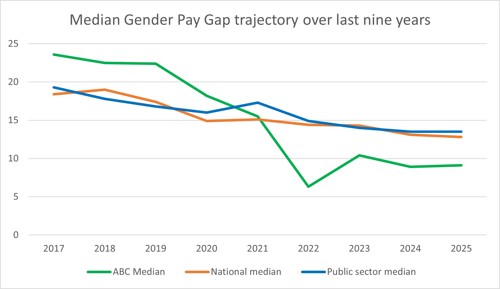
Median (mid-point) gender pay gap in hourly pay 9.1%
| Pay quartile | Men % | Women % |
|---|---|---|
| Top | 50.6 | 49.4 |
| Upper middle | 42.0 | 58.0 |
| Lower middle | 43.6 | 56.4 |
| Lower | 37.6 | 62.4 |
| Mean (average) | 1.2% | |
|---|---|---|
| Median (mid-point) | 0% | |
| Proportion receiving a bonus payment | Males 86.5% | Females 85.5% |
We do not operate a bonus or performance related pay scheme. We calculate our figures according to the gender pay gap legislation using:
- long service awards (two males) and long service awards on retirement (none relevant to this year)
- an informal non-contractual operational arrangement for the provision of a voucher reward scheme at Aspire, the council’s landscape management team (nine males)
- honorariums specific to exceptional performance (one male)
- enhanced recruitment pay (two females)
- any one-off payment associated with the annual pay award that falls under a ‘non-consolidated, one-off, non pensionable payment’ (£350 pro rata).
This includes a non-consolidated, one-off, non-pensionable payment given as part of the pay award for 2024/25. This was £350 pro rata for all staff (unless declined) given in July 2024.
This immediately meant that under the legislation more females than males received a ‘bonus’ payment. However only those still in employment on the snapshot date of 31 March 2025 were included in the calculation, and this combined with long service awards, the Aspire voucher scheme and enhanced recruitment pay showed males receiving slightly more on average. The bonus gap is expressed as the difference in average pay between the men and women in a workforce, expressed relative to men’s earnings.
At mid-point there was no difference in payment due to the large numbers of both genders receiving the same amount.
What do our calculations mean?
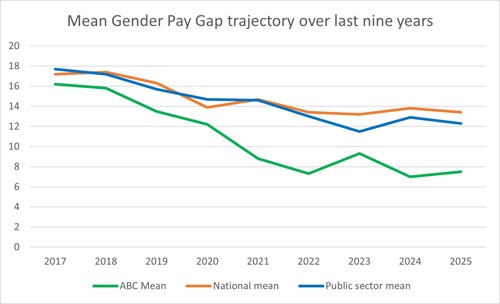
There has been a small increase in our gender pay gap figures as our workforce fluctuates but we have no big concerns and we will continue to ensure women have the same opportunities as men to fulfil their potential in the workplace.
Our pay structure, policies, recruitment procedures and training programme are set without bias to gender or any other personal characteristic. Many of these policies and procedures assist both our male and female staff in a work-life balance and career progression opportunities. We will continue to ensure women have the same opportunities as men to fulfil their potential in the workplace.
Examples of the type of work that we will continue to expand on to assist in closing our gap in the coming years will include:
- Providing interview training for recruiting managers including removing subconscious bias
- Emphasising the value of one to ones and Personal Development Plans
- Speaking to young people at careers fairs and assisting with mock interviews
- Ensuring that some training is online or when in person it is local where possible
- Highlighting the importance of a work life balance and good wellbeing
- Using e-learning and SDI training to recognise our differences, nurture acceptable and eliminate unacceptable behaviour
- Embedding our flexible working and remote working policies and discussing these at interview stage
- Looking at secondment opportunities and flexible ways of recruiting to a post
- Promoting peer support groups (for example menopause and neurodiversity
- Highlighting hybrid and flexible working on our website for job seekers
- Continuing to support flexible working applications from both genders to destigmatise men working part time and give all opportunity for flexibility
- Supporting shared parental leave which can spread both parents and normalise men taking equal caring responsibilities
Here is a link to an infographic for our March 2025 statistics shown below