




Community Governance Review (CGR)
Ashford Town Council – paused.
The council decided in July 2026 to create an Ashford Town Council following the outcome of a Community Governance Review. The review was instigated by the council as it wished to check our local democratic arrangements were best designed to serve residents and communities in light of Local Government Reorganisation (LGR) in Kent which would see the Borough Council replaced with a larger Unitary Council in 2028.
Ministers have since asked councils to pause work that depends on a specific LGR decision, including activity based on the proposed four-unitary model for Kent and Medway. Whilst proposals for an Ashford Town Council were not part of LGR, the decision to create one was based on LGR happening in 2028. In light of the LGR pause, Full Council at its meeting on 15 October decided to pause the implementation of the Town Council.
Whilst the Ashford Town Council has not been cancelled, we will await further government guidance on LGR before reviewing what the future of the town council is. What we do know is that the pause means the Town Council will no longer be implemented in April 2027 as planned.
Background to the Review:
Review Completed
The Community Governance Review for the unparished area of Ashford was completed in July 2026. Following two stages of public consultation, a final report was considered by Full Council in July 2026, which approved the creation of a new Ashford Town Council.
To support implementation, a Town Council Advisory Group was established. The group was overseeing the arrangements required to establish the new council, including governance, finances, staffing and service delivery considerations.
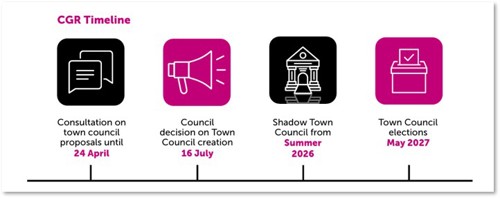
Ashford Town Council was due to be established on 1 April 2027, with the first elections taking place on 6 May 2027. These dates will no longer be met due to the Town Council work being paused in light of the changes to LGR.
Why did we conduct this review?
This consultation was carried out as part of a Community Governance Review. This was a legal process that examined how local areas were represented and whether any changes were needed.
At the time, the main built-up area of Ashford did not have a town or parish council. The review considered whether this should change.
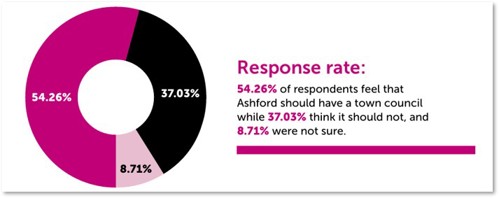
In the first stage of the review, residents living in the review area were asked for their views on creating a town council for Ashford. Most respondents supported the proposal.
Based on this feedback, further proposals were developed. These included the proposed name of the new council, the number of councillors, and how the area could be divided into wards. Respondents were also informed that it was likely a precept would be required to support the creation of a town council, although exact details were not available at that stage.
A second stage of consultation was then undertaken to gather views on these proposals and on whether a town council would help to improve local democracy and community representation in Ashford.
The consultation has now concluded. Following two stages of public consultation, a final report was considered by Full Council in July 2026, which approved the creation of Ashford Town Council. A Town Council Advisory Group has since been established to oversee implementation. Ashford Town Council is due to be established on 1 April 2027, with the first elections taking place on 6 May 2027.
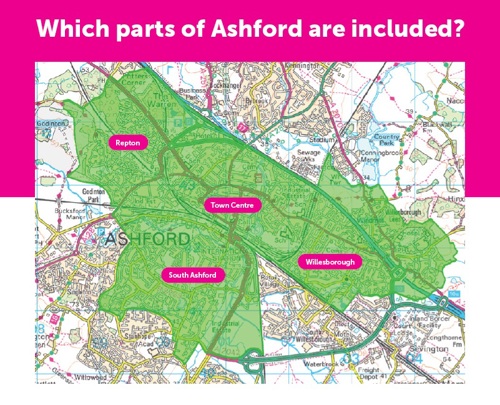
Which parts of Ashford are included?
As shown by the green highlighted areas on the consultation map, the review area included Town Centre, Willesborough, Repton and South Ashford.
Would you like further information?
Please note the survey has now closed. We will provide further updates on the next steps in due course.
If you would like to know more please email corporatepolicy.team@ashford.gov.uk, phone 01233 331111 or write to:
Corporate Policy Team
Ashford Borough Council
International House
Dover Place
Ashford
Kent
TN23 1HU.
Frequently Asked Questions
+ What is a Community Governance Review?
A Community Governance Review (CGR) is a review carried out by a principal council (in this case Ashford Borough Council) and is used to check whether local arrangements should be changed for town and parish councils.
A CGR can look at the whole or part of an area to consider:
- The creation, merger, alteration of parishes
- The naming and the style of new parishes
- The electoral arrangements for parishes such as the ordinary year of election, council size, wards and numbers of councillors
- The grouping or de-grouping of parishes.
The CGR recommendations must:
- Improve community engagement
- Bring communities closer together
- Create better local democracy
- Result in more effective and convenient services
The law allows us to use a review to assess and make changes to community governance within our area. The government’s website has guidance about CGRs.
Ashford Borough Council is looking at whether its unparished area of the borough should have a town council.
+ Why are we conducting a Community Governance Review of Ashford’s unparished urban area?
In the biggest shake up of local government in almost 50 years, the Government want us to merge councils across the historic county of Kent to create a number of unitary councils serving roughly 500,000 people each. This is known as Local Government Reorganisation or LGR for short.
From 1 April 2028, the county and borough councils will no longer exist. In the parished areas of the borough there will be two tiers of local government – parish/town councils and a unitary council. In the unparished area of Ashford (which we are reviewing) there will only be one tier – the unitary council.
Ashford is the only area of the borough which has neither a parish nor town council, with all local services currently provided by the borough and county councils. A new town council, serving around 18,500 households, could take on responsibilities such as allotments, open spaces, community schemes and support for tourism. It may also represent the interests of the community on a range of matters.
If a new town council is formed, it is expected that elections could take place in 2027 to align with other parish and town councils.
+ What is a town council?
A town council is the first tier of local government. They are separate elected bodies made up of local people representing the interests of their community. They have the same powers and can provide the same services as a parish council.
They can be the voice of their local community and work with other tiers of government and external organisations to deliver services and improve the quality of life in the area.
Town councils have relatively few statutory functions (things they have to do). The statutory functions are, for example, the holding of meetings, the management of finances and the preparation of annual accounts. A town council employees staff, owns and manages premises and provides services.
A town council has the same powers as a parish council.
+ What responsibilities do a town council have?
Through an extensive range of discretionary powers, which they can choose to exercise, councils like these can provide, maintain and support a variety of important and visible services including:
• allotments, parks and open spaces
• bus shelters and community transport schemes
• community centres and leisure facilities
• crime reduction and community safety measures
• festivals, celebrations and tourism activities
• litter bins, street lighting and street cleaning
A town council, which will be made up of elected councillors, provides an extra voice to represent the community. They provide a point of contact to either help you directly or point you in the right direction.
+ Is there a difference between a parish and town council?
+ What are the benefits of having a parish or town council?
Some of the benefits of having a parish or town council include:
• Community representation - they give residents a stronger voice in local affairs, ensuring their needs and preferences are directly addressed.
• Focused development - they can drive community projects and initiatives tailored to local needs, such as environmental conservation or youth programs.
• Economic advantages - they can attract funding and grants unavailable to larger councils. They can also promote local businesses through initiatives and events, boosting the local economy.
• Improved quality of life - they can work on projects that enhance the quality of life, such as creating green spaces, supporting local sports teams, and organising cultural events.
• Greater accountability - they are closer to their residents, leading to more accountability and transparency in decision-making.
There is lots of information about Town Councils available through the National Association of Local Councils (NALC) Homepage.
Ashford currently has 39 parish councils, 1 town council, 2 community councils and a Parish Meeting in the borough of Ashford. You can find information about them on our website.
+ How is a town council funded?
Town councils are funded through a sum of money called a ‘precept’.
This is a separate charge which is added to, and collected together with, your Council Tax.
Town councils set their own precept and the amount charged depends on the levels of service they choose to provide.
Town councils are not limited in the amount of precept they can collect.
+ Would having a parish or town council make a difference to my Council Tax?
Yes. There would be an overall increase in your Council Tax arising from the additional overheads and any extra services a parish or town council chooses to deliver. The average Band D precept charged by parish and town councils in 2025/26 is £92.22.
Across the Ashford Borough, the average Band D precept charged by parish and town councils in 2025/26 is £70.00. The lowest precept being £16.53 (Sevington) and the highest being £181.36 (Tenterden).
A town council precept amount depends on the size of the parish or town, the services it provides and the number of properties across which it is spread. It is not possible at this stage to say how much an Ashford precept would be, and it would depend on the services and facilities it wants to provide.